Most people are familiar with Hollies because of their popular use during the holidays to decorate wreaths, centerpieces, and other arrangements. The crinkled, evergreen leaves and red berries have long been a symbol of everlasting life, adopted by Druids and Christians alike for religious ceremonies.
Hollies belong to the genus Ilex, which is a broad group of more than 400 species that includes both evergreen and deciduous examples. Many are valued for their landscape characteristics and ability to attract wildlife. This guideline will familiarize you with the most widely grown varieties.
All Hollies are dioecious, meaning that they bear male or female flowers on separate plants, which means that you need a male pollinator nearby to allow the female plants to set fruit. Likewise, they almost all grow best in moist but well-drained, acidic soil with ample organic matter, making them ideal companions to Rhododendrons and Azaleas which prefer similar conditions.
Ilex opaca – American Holly
The American Holly is probably what most people think of when they hear the word “Holly.” It is a large, evergreen, upright shrub, growing up to 35’ at maturity with a spread of 25’. Birds love the red berries it produces. The species name opaca refers to the dull green leaves, but many cultivars have a more lustrous appearance to their leaves. The American Holly is also noted for its resistance to deer damage. All are hardy to Zone 5 unless otherwise indicated. Cultivars include:
David Leach – a male form, noted for its shiny dark green leaves
Jersey Princess – primarily grown for its abundant production of red fruit
Miss Helen – also grown for its fruit, with olive green leaves and a height of 40’
Satyr Hill – considered one of the best female forms, dark olive-green leaves and abundant fruit, pyramidal in form
Green Holly Bush leaves with a cluster of vibrant red berries.
Ilex aquifolium – English Holly
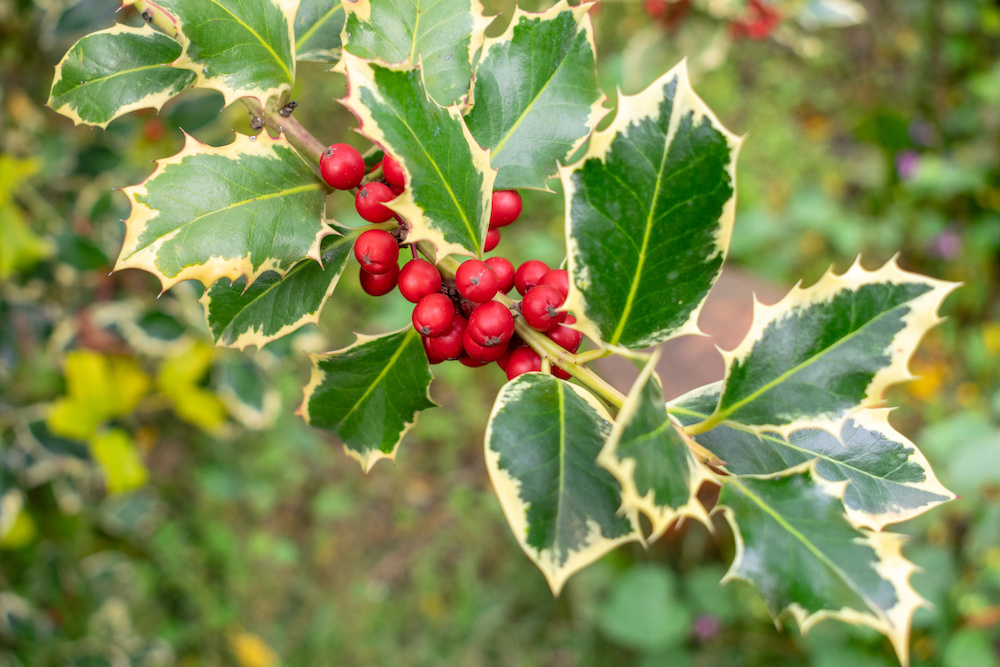
Considered by many to be a better ornamental plant than the American Holly, probably because of its glossy, although spiny, leaves and slightly smaller stature. The “problem” for American gardeners is that it is hardy only to USDA Zone 7 – out of reach for most New Englanders. However, hybrids have been introduced that retain these characteristics but will survive harsh winters.
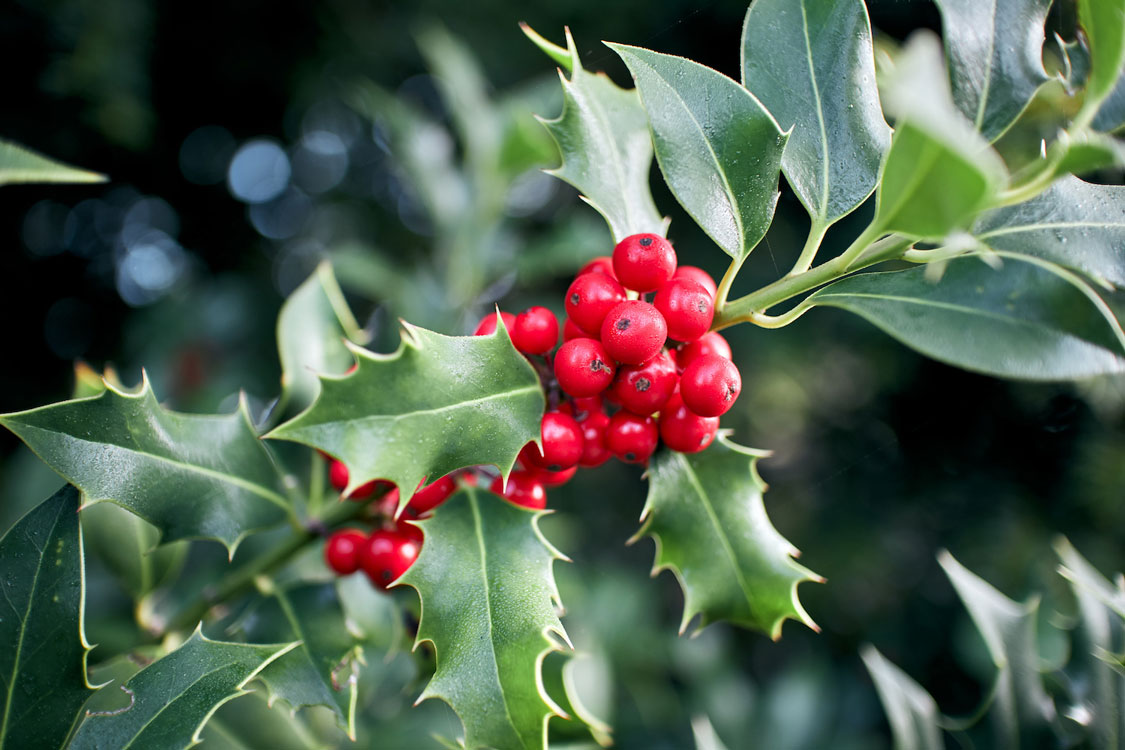
Holly (Ilex aquifolium) branch with bright red berries, Christmas plant commonly mistaken as mistletoe
The Blue Hollies
The most famous of these hybrids is the so-called ‘Blue Hollies’ resulting from a cross between the English Holly and Tsuru Holly, and named for the hybridizer Kathleen Meserve (1906-1999). The Blue Hollies are hardy to Zone 5 unless noted otherwise.
Blue Prince/Blue Princess – male and female forms of Ilex x meserveae, bushy, evergreen shrubs with red berries typically growing 6-8’ tall
Castle Wall/Castle Spire – male and female versions featuring an upright, narrow form with superior vigor and glossy green leaves, ideal for hedging, accents, and even as a specimen, growing up to 10’ tall and 3-4’ wide
Centennial Girl – a female cross also bred for its winter hardiness, matte green foliage with bright red berries, 12-15’ tall, 5-8’ wide
China Boy/China Girl – Hardy to Zone 4, and tolerant of summer heat, this mounding evergreen sports a profusion of red berries in fall, 8-10’ tall and 6-8’ wide
Dragon Lady is a cross between the English Holly and the Perny Holly, this selection is upright (10-20’ H) and narrow (4-6’ W), Zone 6
San José – a cross between Ilex aquifolium and Ilex latifolia, this cultivar grows into a stately 15-25’ tall and 10-15’ wide, glossy, dark green leaves and showy red berries; hardy to Zone 6
Ilex crenata – Japanese Holly
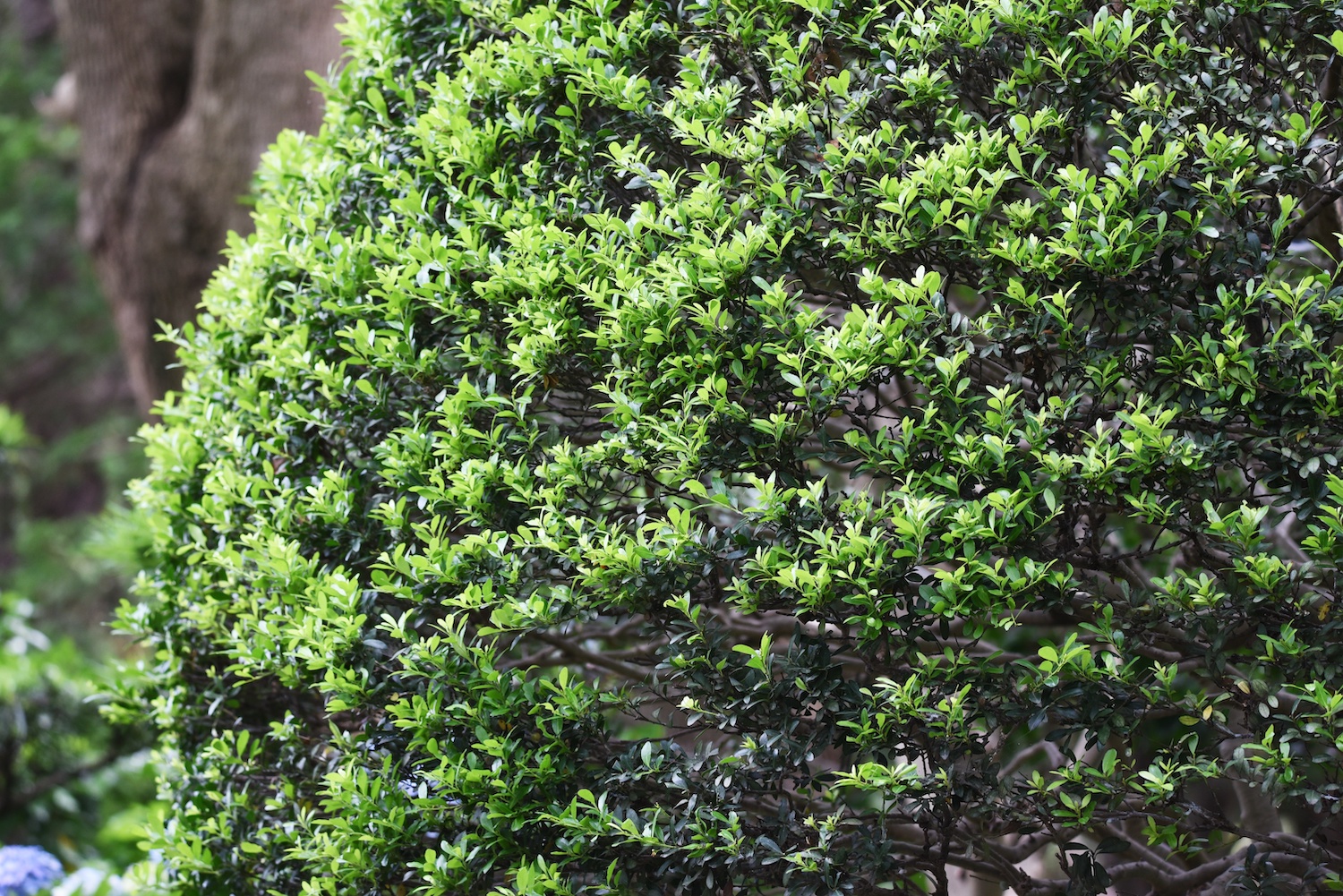
Japanese Hollies are very popular for landscape use in New England because of their evergreen foliage, compact growth, and hardiness, but they need moist, acidic soil. There are many cultivars, but the tiny black fruit they produce is not showy.
Compacta – at only 5 feet tall with a spread of 6 feet, this plant is widely used for screening, hedges, and mass plantings
Green Lustre – a hardy selection with glossy green leaves, mounding in habit, 4’ high x 8’ wide, produces small black fruit in winter
Helleri – mature at 3’ high and 4’ wide, dark green leaves and small black fruit, rounded shape, takes pruning well, hardy to Zone 6
Hoogendorn – also 3’ high x 4’ wide, but upright spreading habit, hardy to Zone 5, will grow in moist to wet soils, not tolerant of urban sites
Sky Pencil – a stiff, upright selection, growing 8’ tall while only 24” wide, grows best in full sun to part shade, average to moist soil, hardy to Zone 6
Soft Touch – a 3’ dwarf with incredibly glossy, soft-to-the-touch leaves, this variety is tolerant of a wide range of soils, including clay, and drought once established
Steeds – a pyramidal form at 5’ x 4’, with curved, glossy green leaves, it takes pruning very well
Ilex glabra – Inkberry Holly
An evergreen shrub native to Eastern North America, the Inkberry Holly’s dark fruit was used in Colonial New England as a dye substitute for Indigo. The fruit is not particularly showy, but this plant’s glossy, evergreen leaves are especially welcome in winter. This is the only Holly that spreads by underground “stolons” – it can form a colony of its own. Noted cultivars include:
Shamrock – a compact and dwarf form, growing only 4’x 4’, making it ideal for hedging, massing, and even topiary
Gem Box – even more dwarf than Shamrock at 3’ x 3’, this plant looks more like a Boxwood than a Holly
Compacta – also a small shrub at 4’ x 4’, its foliage is a lighter green than Shamrock
Densa – a medium-sized form at 8’ x 10’, this cultivar has a dense, uniform habit
Ilex pedunculosa – Longstalk Holly
This is probably one of the more unusual Hollies on our list; the common name refers to the long stem that the red fruit hangs from. The evergreen leaves are reminiscent of Mountain Laurel foliage. Loose and open in form, it grows up to 15’ tall. Birds are attracted to the fruit. Hardy to Zone 5. No cultivars; need both male and female plants for fruit.
Longstalk Holly
Ilex verticillata – Winterberry
Another North American native, the Winterberry is a deciduous Holly, meaning it drops its leaves in winter, but this only makes the showy red fruit even more prominent. Seldom bothered by deer, this plant is often found growing at streamsides or near a pond, but it adapts well to ordinary garden conditions. Most are hardy to Zone 4. The fruit is adored by birds, but usually not until late winter. Cultivars include:
Berry Heavy, Berry Nice, Berry Gold – all cultivars specifically chosen for their larger and more numerous fruits, Berry Gold exhibits yellow fruit
Berry Poppins – heavy fruit set on a dwarf, 3-4’ plant
Red Sprite – a dwarf form that grows only 3-4’ high and wide, but covers itself with showy red berries
Sparkleberry – Red fruit on a large plant, 12’ x 8’
Winter Red – a large form, 8’x 8’, selected for its abundant production of cherry-red fruit
Winter Gold – large form, but produces brilliant orange-yellow fruit
Design Services
Get expert help in designing your perfect outdoor space!
Expert Landscape Designers
Our designers have decades of experience!
Design Consultations
Design consultations start at only $300!
Top Quality Plants
Over 100 years of excellence in providing top-quality plants!